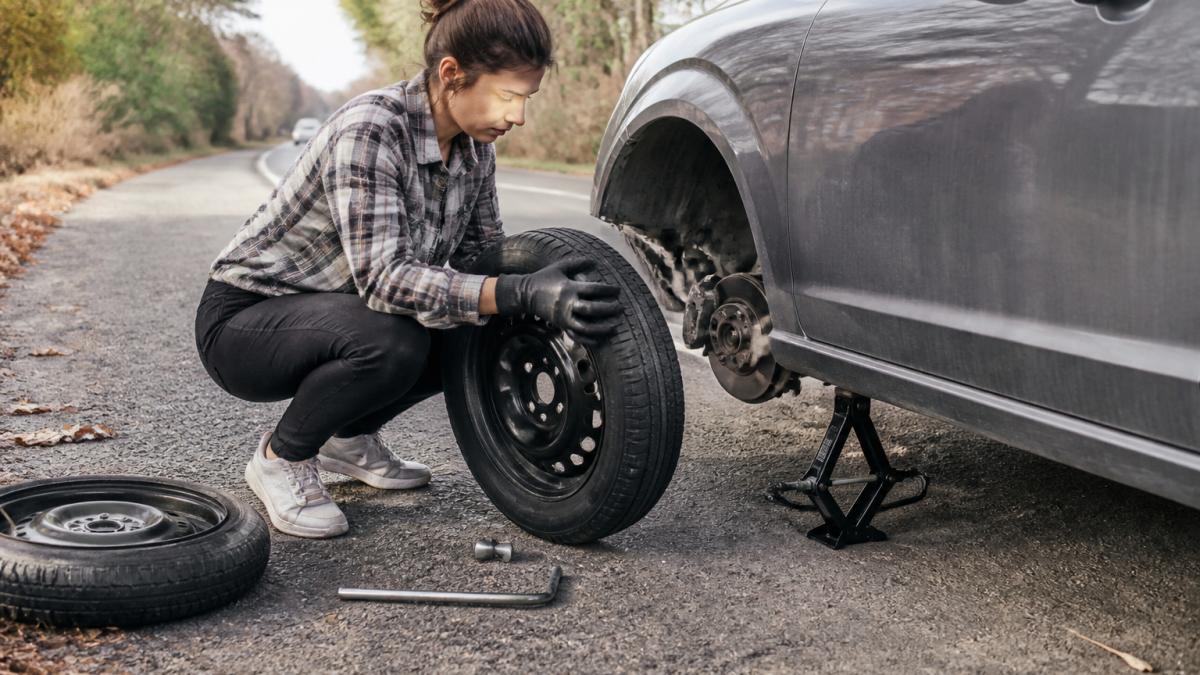
 how-to
How to Change a Flat Tire Safely: Step-by-Step
Table of Contents
- What to Do When You Get a Flat Tire: First Steps That Keep You Safe
- How to Use a Car Jack to Change a Tire
- How to Install a Spare Tire and Lower the Vehicle
- How Long Can You Drive on a Spare Tire?
- When Not to Change a Flat Tire Yourself
- What to Do If You're Missing Tools or a Usable Spare
- Post-Change Checks and Follow-Up
- Frequently Asked Questions
Last Updated: October 4, 2026
What to Do When You Get a Flat Tire: First Steps That Keep You Safe
A flat tire rarely happens at a good time. Knowing how to change flat tire safely starts before you touch a jack, and the first 60 seconds after that thump matter most.
The National Highway Traffic Safety Administration tracks thousands of roadside crashes each year, many involving pedestrians struck near disabled vehicles. Your goal: get off the road, get visible, and stay out of traffic lanes.
Find a Safe, Level Place to Stop
Do not stop the moment the tire blows, a busy road is not the place to park.
Instead:
- Keep both hands on the wheel and ease off the gas
- Turn on your hazard lights right away
- Coast or steer slowly to a flat, level spot away from traffic
Level ground matters because a jack can slip on a slope. Firm pavement or packed gravel works best. Soft dirt, sand, or grass gives the jack nothing to grip.
Secure the Vehicle and Set Up Visibility
Once stopped, put the car in Park or first gear and set the parking brake so it can't roll while lifted.
Next, make yourself visible:
- Leave hazard lights flashing
- Set out reflective triangles or flares if you have them
- Turn on your dome light or headlights if it's dark
Have passengers exit on the side away from traffic and stand behind the guardrail or off the shoulder. Never let anyone sit in the car while it's on a jack.
How to Use a Car Jack to Change a Tire
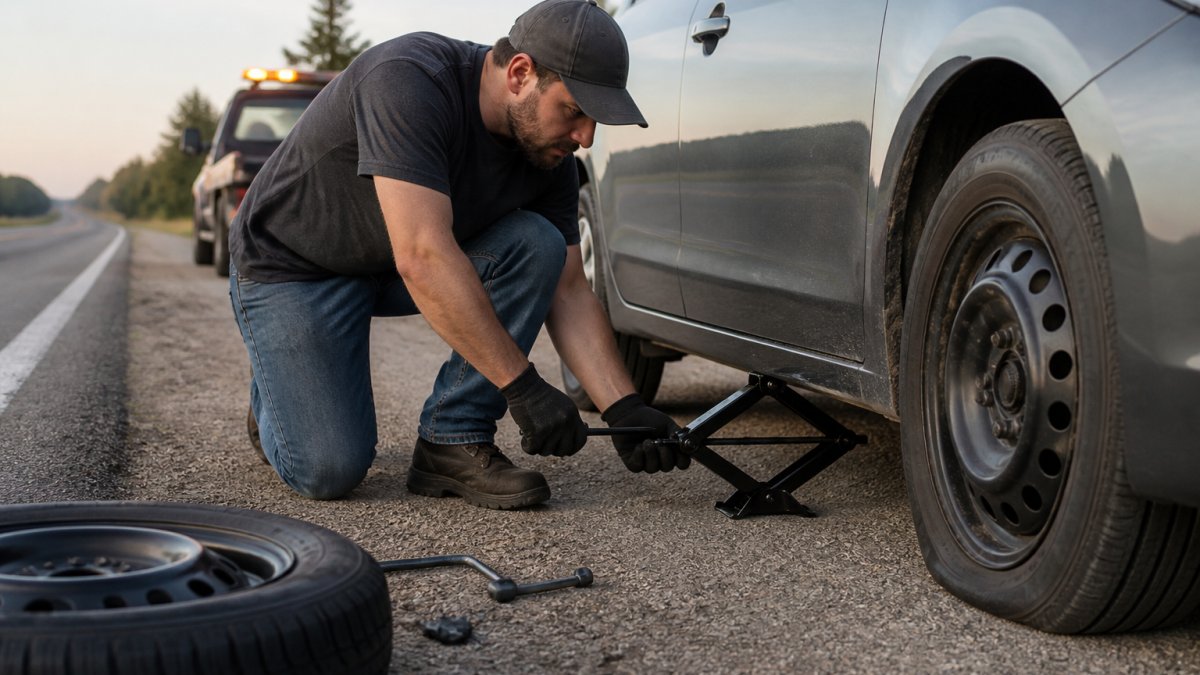
Using a car jack safely comes down to three things: the right jack point, a firm surface, and loosening the lug nuts before the car goes up. Skip one and you risk a dropped vehicle or a stripped wheel stud.
Check What Your Vehicle Actually Has
Before you start, gather everything you need, and confirm it exists:
- Spare tire (check that it holds air)
- Lug wrench or wheel wrench
- Scissor jack or floor jack
Many new vehicles, especially hybrids, EVs, and some low-clearance sports cars, carry a tire inflator kit, sealant kit, or run-flat tires instead of a spare. If that's your situation, follow the manufacturer's instructions; the procedure below may not apply. A sealant kit also won't fix a sidewall puncture, blowout, or large tear.
Electric and Hybrid Vehicles
EVs and hybrids often have different jack points than gas cars, and some have a high-voltage battery pack under the floor that must never be used as a lift point, damage to the battery enclosure is expensive. Check the owner's manual for exact lift points and never assume a reinforced rail is safe to jack on. Some EVs also outweigh comparable gas cars, so a standard scissor jack may be at or beyond its rated capacity.
Low-Clearance Cars
Low-clearance vehicles may not have room to slide a scissor jack under the lift point. Use a low-profile floor jack, or drive onto a short piece of lumber to gain a few inches. Never force a jack under by rocking the vehicle.
Run-Flat Tires and TPMS
With run-flat tires, a slow puncture may not require a change at all, you can drive to a shop within the manufacturer's distance and speed limits. But run-flats can't always be repaired, and a sidewall puncture usually means replacement. If your car has TPMS, the warning light will likely stay on after a spare is installed; that's normal.
Locate the Jack Point and Loosen Lug Nuts First
The jack point is a reinforced spot on the frame, not the plastic body panel. Your owner's manual shows exactly where it is; on many vehicles it's marked by a notch or arrow on the rocker panel.
Once you've found it:
- Place wheel chocks behind the wheel opposite the flat
- Fit the lug wrench on each nut and turn counterclockwise a quarter turn
- Do this for every nut before lifting
- Position the jack under the correct jack point
- Raise the vehicle until the flat tire clears the ground by an inch or two
Keep the jack on solid, level ground; if it's soft, place a sturdy board under the base. With a locking lug nut, fit the key onto the wrench before applying force.
How to Install a Spare Tire and Lower the Vehicle
Installing a spare is the reverse of removal, with one extra step: tightening in a star pattern. Once the flat is off, slide the spare onto the hub and hand-thread each lug nut until snug.
Lower the jack until the tire just touches the ground, then tighten the nuts in a star pattern. This spreads pressure evenly and seats the wheel flat against the hub.
Tighten Lug Nuts in a Star Pattern
The star (or cross) pattern means tightening nuts across from each other rather than next to each other. On a five-lug wheel the order is 1, 3, 5, 2, 4; on a four-lug wheel, 1, 3, 2, 4.
Follow these steps:
- Snug each nut by hand in the star order
- Lower the vehicle fully to the ground
- Tighten each nut firmly in the same star order
Get the nuts as tight as you can by hand with the wrench; most drivers can't reach full torque roadside, so have them checked soon.
| Step | Action | Why It Matters |
|---|---|---|
| 1 | Loosen nuts before lifting | Prevents wheel spin |
| 2 | Raise at the correct jack point | Avoids body damage |
| 3 | Hand-thread nuts on the spare | Prevents cross-threading |
| 4 | Tighten in a star pattern | Seats the wheel evenly |
| 5 | Re-check torque soon after | Prevents a loose wheel |
How Long Can You Drive on a Spare Tire?
Most temporary spares, "donuts", are rated for roughly 50 miles at no more than 50 mph. That limit isn't arbitrary: a temporary spare is narrower, lighter, and has less tread depth, so it heats up faster and grips less. Pushing past the rating can overheat the tire and, on all-wheel-drive and limited-slip vehicles, stress the differential or transmission.
Read Your Spare's Sidewall, Not a General Rule
The 50/50 figure is a common ceiling, not a universal spec, your spare's sidewall carries the actual rating, and those numbers override general advice. Look for a maximum speed marking (often "M" for 81 mph, "N" for 87 mph, or a specific mph figure) and a temporary-use warning. Some compact spares are rated lower than 50 mph or for a specific distance.
Full-Size Spares, Run-Flats, and TPMS
A full-size spare matching your road tires can be driven normally, but only at correct pressure. Check it with a gauge first, one that's sat in a trunk for two years is often 10 to 15 psi low.
With TPMS, the warning light will likely stay on after you install a spare, since the spare usually has no sensor or an unpaired one.
Practical Rules for the Road
- Treat a temporary spare as a short trip to the nearest shop, nothing more.
- Avoid highways and high speeds. Stay off interstates if you can.
- Skip detours. Every extra mile counts against the rating.
What Happens If You Ignore the Limit
Driving a temporary spare beyond its rating rarely fails instantly, the damage accumulates. The tire overheats, tread separates, and the sidewall weakens, while the drivetrain works harder to compensate for the size mismatch, shortening the life of a differential or transmission. That repair costs far more than a tow.
When Not to Change a Flat Tire Yourself
Some situations call for a tow, not a tire change. If any of these apply, stay in a safe spot and call for help:
- You're in a live traffic lane and can't get clear
- The ground is soft, sloped, or unstable
- You're on a bridge, in a tunnel, or on a narrow shoulder
Modern vehicles add another wrinkle: some have no spare, just a repair kit or run-flats, and others have a locking lug nut needing a special key. Check your owner's manual before you need it.
What to Do If You're Missing Tools or a Usable Spare
No jack, no wrench, or a flat spare? You have options, and none involve improvising with a rock.
First check for a hidden spare, many trucks and SUVs store it under the rear, and some cars hide a repair kit in the trunk floor.
If the tools or spare are truly missing:
- Call roadside assistance and stay with your vehicle
- Use a tire inflator if you have one and the leak is slow
- Move to the safest spot you can reach and wait
A temporary spare that's been sitting flat for years is useless. Check its pressure every few months.
Post-Change Checks and Follow-Up
The job isn't done when the spare is on. Before driving away, do a quick walk-around:
- Confirm all lug nuts are tight
- Check that the spare has air
- Make sure the flat tire and tools are stowed
Have the lug nuts re-torqued to the manufacturer's spec within the first 50 miles, most tire shops do it free. Then get the damaged tire repaired or replaced.
For Buffalo-area drivers who'd rather not deal with this roadside, Backwoods Towing offers 24/7 roadside assistance, including tire changes, fuel delivery, jump starts, and lockout help. Customers often mention our clear communication and updates while their vehicle is serviced, and we follow through on every call.
Frequently Asked Questions
Do you tighten lug nuts before lowering a car?
Yes. Tighten the lug nuts in a star pattern while the vehicle is still raised, but only until they are snug. Once the car is lowered and the full weight is on the tire, go back and tighten them fully in the same star pattern. Tightening while the wheel is still in the air prevents the tire from spinning and gives you the leverage to seat the nuts properly.
How long can you drive on a spare tire?
A temporary spare is designed for short distances at reduced speeds, typically around 50 miles at no more than 50 mph. Check your owner's manual for the exact limit, since it varies by vehicle. Driving farther or faster can damage the spare and the vehicle. Get the original tire repaired or replaced as soon as possible.
What should you do if you do not have a spare tire?
If your vehicle has no spare, call roadside assistance and stay with your car in a safe location away from traffic. Many newer vehicles use run-flat tires or a tire sealant kit instead of a spare. Run-flats let you drive a limited distance at reduced speed, but sealant kits only work on small punctures and cannot fix a blowout or sidewall damage.
Is it safe to change a tire on the side of the road?
It can be safe if you pull fully onto the shoulder, turn on your hazard lights, set the parking brake, and stay visible. Avoid changing a tire on a narrow shoulder, in a curve, or in heavy traffic. If you cannot get far enough from moving vehicles, call for professional roadside help and wait in a safe spot away from the road.
A flat tire on a dark back road is stressful, and doing it yourself isn't always the safe choice. When the situation is risky, the weather is bad, or you're not sure your tools will do the job, Backwoods Towing is ready to help. We're available 24 hours a day, seven days a week, with local service across Buffalo and the surrounding area, plus vehicle recovery and winch-out assistance when you're stuck off the road. Get started with Backwoods Towing and get back on the road safely.