 how-to
How to Get Unstuck From Mud: 7 Proven Methods
Table of Contents
- Assess Your Situation Before You Act
- What to Put Under Tires for Traction in Mud
- How to Rock a Car Out of Mud
- How to Get a Vehicle Out of Mud Without a Tow Truck
- Common Mistakes That Make You Sink Deeper
- When to Stop Trying and Call for Stuck in Mud Roadside Assistance
- Getting Back on the Road Safely
- Frequently Asked Questions
Last Updated: October 8, 2026
Assess Your Situation Before You Act
Getting stuck in mud is stressful, but rushing into a solution often makes things worse. Before you try anything, take a moment to evaluate what you're dealing with.
Start by checking how deep your vehicle has sunk. Are your tires just barely touching mud, or is the undercarriage sitting in it? Look at the terrain around you. Is the mud thick and clay-like, or is it more of a soupy mix? Check the ground slope. Are you on flat land or tilted at an angle?
Next, assess your traction options. Do you have items nearby you could use? Check your vehicle's condition. Is the engine running smoothly? Are your tires intact? Test whether your wheels will spin if you gently press the gas.
This evaluation takes two minutes but saves you hours of spinning tires and digging deeper.
What to Put Under Tires for Traction in Mud
The simplest way to get unstuck from mud is to improve traction under your tires. When wheels spin freely in mud, they dig deeper. Adding material under the tires gives them something to grip.
Best materials to use:
- Branches and logs, Gather fallen branches, small logs, or driftwood. Lay them perpendicular to your tire direction. Stack them to create a platform.
- Rocks and gravel, Larger rocks work better than fine gravel. Place them under the tire in a line pointing forward.
- Cardboard or plywood, If you have sheets in your vehicle, lay them flat under the tires. They compress but still provide grip.
- Sticks and twigs, Bundle small branches together under each wheel. They mat down and create friction.
- Sand or dirt, Pour sand directly under tires if you have a bag in your vehicle. Pat it down firmly.
- Mulch or wood chips, If available nearby, pile it under the tires. It compresses and creates traction.
- Rubber mats or floor mats, Use the mats from inside your vehicle. Place them under the drive wheels.
The key is creating a firm surface your tires can bite into. Mud alone has no friction. Adding any solid material improves grip significantly.
Start with materials closest to you. Don't spend 30 minutes searching for the "perfect" solution when branches are right there.
How to Rock a Car Out of Mud
Rocking is one of the most effective ways to get unstuck from mud without outside help. It uses momentum to break the mud's grip on your tires.
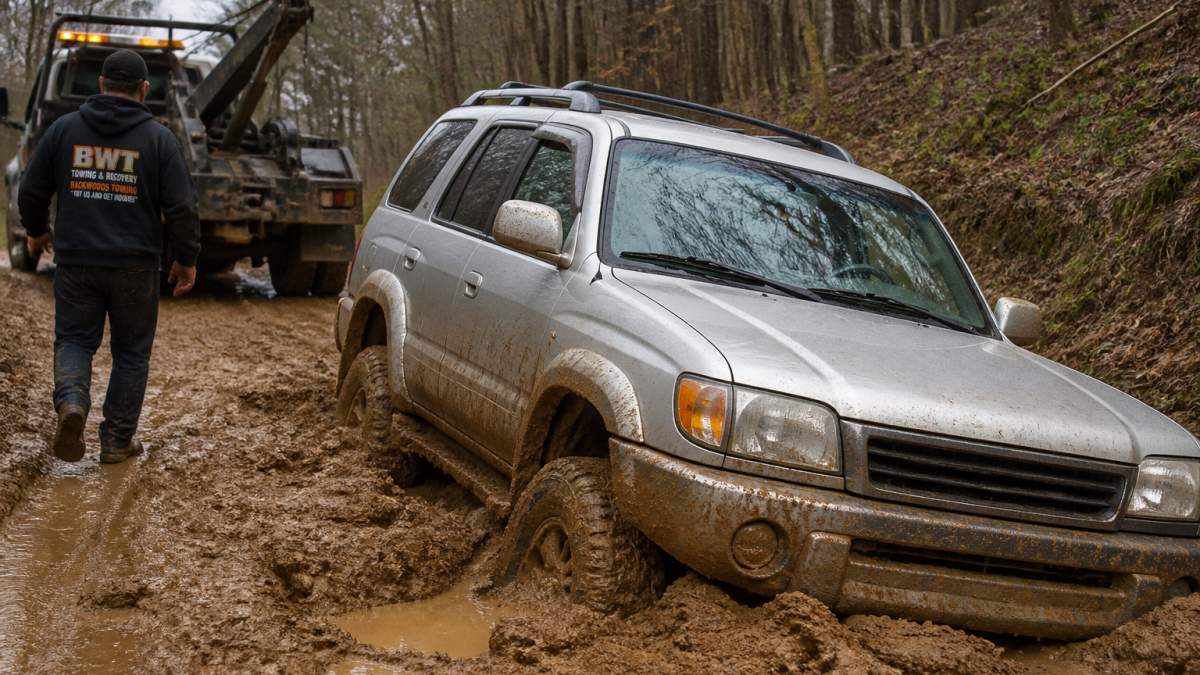
The rocking method works like this:
- Start in Reverse, Put the vehicle in Reverse and gently press the gas pedal. Let the wheels spin just enough to move backward a few inches.
- Shift to Drive, Quickly shift to Drive and press forward. The wheels will move ahead a few inches.
- Repeat the pattern, Alternate between Reverse and Drive. Each cycle should move you slightly forward or backward.
- Build momentum, After 5-10 cycles, you'll feel the vehicle moving more freely. Keep the rhythm steady.
- Accelerate out, Once you've created space, press the gas harder and drive out of the mud.
The rocking motion works because each shift creates a small escape route. The mud compresses differently with each direction change, gradually loosening its grip.
Important tips for rocking:
- Keep your foot off the gas between shifts. Let momentum do the work.
- Don't spin the wheels aggressively. Gentle, steady rocking works better than violent spinning.
- If the vehicle doesn't move after 10 rocks, stop and try a different method.
- Rocking works best in shallow mud, not when you're deeply stuck.
This technique requires patience. It usually takes 30 seconds to 2 minutes of rocking before you break free.
How to Get a Vehicle Out of Mud Without a Tow Truck
If rocking doesn't work, you have several other options before calling for help. These methods use items you likely have nearby or can find quickly.
Using a stick or branch as a lever:
Find a sturdy stick or small log. Place it under the frame near a wheel, using a rock as a fulcrum. Push down on the stick to lift the wheel slightly, which reduces the mud's suction.
Deflating tires slightly:
Lower your tire pressure by 5-10 PSI. This increases the tire's contact area with the ground, improving grip. You'll need a tire gauge and air pump to reinflate later, but this method works in a pinch.
Using a come-along winch:
If you have a hand winch in your vehicle, attach it to a nearby tree or rock. Slowly winch yourself out. This method takes time but requires no engine power.
Pushing with another vehicle:
If someone is nearby, they can push from behind while you gently press the gas. Coordinate movements carefully. The pushing vehicle should stay out of the mud.
Creating a path with digging:
Use a shovel, stick, or even your hands to clear mud away from the wheels. Remove mud from in front of the tires so they have space to move forward.
Letting air out of tires (emergency only):
As a last resort before calling for help, you can let more air out of the tires. This increases grip dramatically but risks tire damage. Only do this if you're truly stuck and can't move.
None of these methods work if you're deeply stuck or if your vehicle's undercarriage is resting on mud. That's when professional help becomes necessary.
Common Mistakes That Make You Sink Deeper
Most people make the same errors when stuck in mud, and each one makes the situation worse.
Spinning tires aggressively, This is the biggest mistake. Spinning wheels fast creates heat and liquefies the mud around your tires. The vehicle sinks deeper with each spin.
Not adding traction before moving, Trying to drive out of mud without any material under your tires is futile. The wheels will just spin. Always add branches, rocks, or sand first.
Rocking too violently, Slamming between Reverse and Drive doesn't help. Gentle, steady rocking for 30 seconds works better than 10 seconds of aggressive shifting.
Trying to push from the wrong angle, If another vehicle pushes you, it should push straight back along your path of entry. Pushing from the side just buries you deeper.
Ignoring the weather, If it's raining or about to rain, mud gets worse. If you're stuck in light mud, stop attempting recovery before the weather worsens. Call for help immediately instead.
Not checking your fuel, Running out of gas while stuck is a disaster. Check your fuel gauge before attempting recovery. If you're low, call for professional assistance right away.
Overestimating your vehicle's capability, Some vehicles are simply not designed for mud recovery. Sedans, low-clearance cars, and vehicles without proper traction control get stuck more easily and are harder to extract.
Waiting too long before calling for help, The longer you attempt DIY recovery, the deeper you sink and the more damage you risk to your vehicle.
When to Stop Trying and Call for Stuck in Mud Roadside Assistance
There's a point where professional help is the only real option. Recognizing that moment saves time, money, and vehicle damage.
Call for help if:
- Your vehicle hasn't moved after 15-20 minutes of rocking and traction attempts
- The undercarriage is resting on mud (you can see mud under the frame)
- Your wheels are spinning freely but the vehicle isn't moving forward at all
- You're stuck in deep mud (more than 12 inches covering the tires)
- The vehicle is tilted at an extreme angle
- Your engine sounds strained or is overheating
- You're alone and don't have materials nearby to create traction
- Weather is getting worse (heavier rain, darkness approaching)
- Your vehicle is off-road with no clear exit path
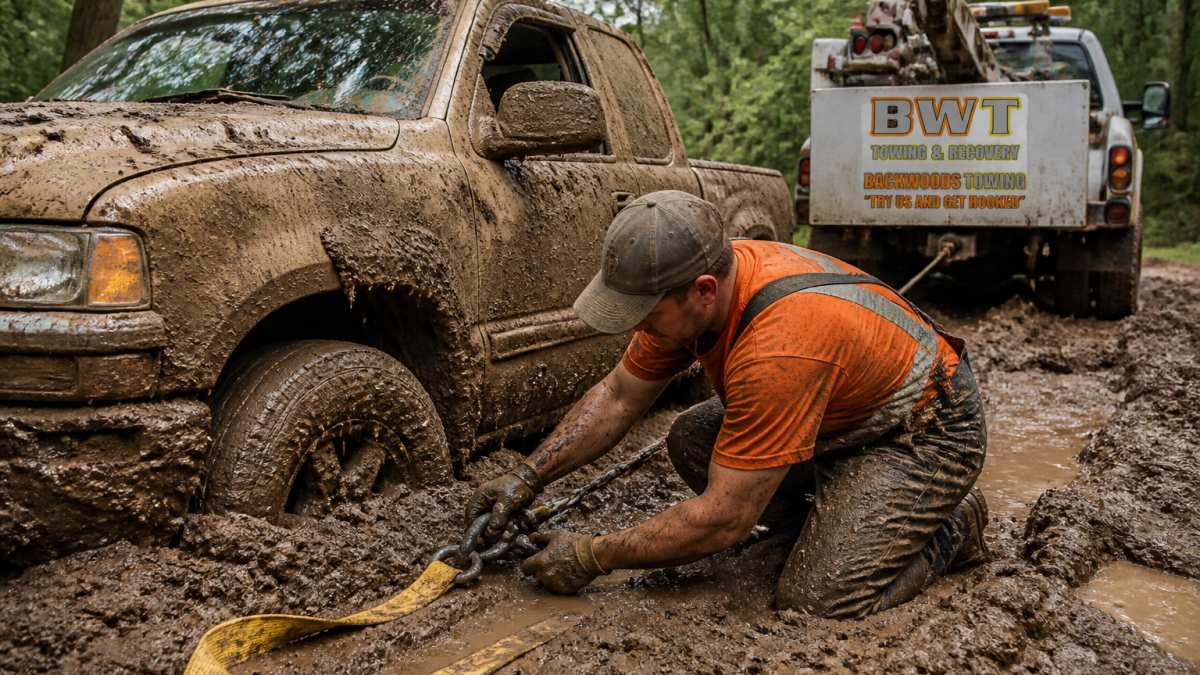
Professional towing services have equipment designed for exactly this situation. Winches, air compressors, and experienced operators can extract vehicles from mud that would take you hours to escape alone.
In Buffalo, Missouri, and surrounding areas, Backwoods Towing offers 24/7 stuck in mud roadside assistance. Our team handles vehicle recovery in all conditions. We have the right equipment and experience to get you out safely without damaging your vehicle.
When you call, have information ready: your location, how deeply stuck you are, and what you've already tried. This helps us arrive with the right equipment.
Getting Back on the Road Safely
Once you're free from the mud, you're not done yet. Your vehicle needs checking before you drive normally.
Inspect your tires, Look for punctures, cuts, or damage from the mud and recovery process. Check tire pressure and reinflate if you let air out. Damaged tires should be replaced before highway driving.
Check your undercarriage, Look underneath for mud caked on the frame, suspension, or brake components. Dried mud can cause problems. Rinse the undercarriage at a car wash if possible.
Test your brakes, Drive slowly and apply brakes gently. Mud on brake components can reduce stopping power. If brakes feel soft or unresponsive, stop and have them inspected.
Listen for unusual sounds, As you drive, listen for grinding, clunking, or squeaking. These sounds indicate damage from the recovery process.
Check your alignment, If the recovery process involved heavy pulling or rocking, your wheel alignment may be off. Uneven tire wear will develop quickly if alignment is wrong.
Drive slowly at first, Don't jump on the highway immediately. Drive at low speeds for the first mile to ensure everything feels normal.
Getting stuck in mud is frustrating, but most situations resolve with calm assessment and the right technique. If DIY methods don't work within 15-20 minutes, professional help is the smart choice. Backwoods Towing serves Buffalo, Missouri, and the surrounding region with 24/7 recovery services. Our team has the equipment and experience to extract your vehicle safely.
Frequently Asked Questions
Should you use four-wheel drive when stuck in mud?
Four-wheel drive helps distribute power to all four wheels, improving traction when you're stuck in mud. Engage it before you get bogged down if possible, or use it to help free yourself if your vehicle has the capability. However, four-wheel drive alone won't free a deeply stuck vehicle, you'll still need traction aids like boards or sand, proper tire pressure adjustments, and rocking motions to break free.
Can spinning your tires damage your car when stuck in mud?
Yes. Spinning tires in mud generates excessive heat that can damage your transmission, engine, and tires. It also digs you deeper into the mud by creating a deeper rut around your wheels. Instead, use gentle rocking motions with steady pressure, and stop if you feel resistance. If your wheels spin freely without moving the vehicle, stop and add traction materials under your tires before trying again.
When should you stop trying to free a vehicle stuck in mud and call for help?
Stop attempting recovery if your wheels spin without forward or backward movement, if the vehicle sinks deeper despite your efforts, if you're stuck at an angle or on a slope, or if your vehicle has become high-centered on mud. Continuing to spin wheels or rock aggressively can cause transmission damage and dig you in further. Professional recovery equipment and expertise are safer and faster at that point.
What's the best way to get unstuck from mud using items you have on hand?
Start by reducing tire pressure slightly to increase the tire's contact patch with the ground, then place traction materials (branches, cardboard, sand, or floor mats) under and in front of your wheels. Rock the vehicle gently in reverse and forward to build momentum, shifting between Drive and Reverse without spinning the wheels. If that fails after a few attempts, stop and reassess, further effort risks transmission damage and deeper embedding.