 how-to
8 Reasons Your Car Won't Start After Sitting for a Week
Last Updated: November 4, 2026
Quick Summary
A car won't start after sitting for a week usually has a battery problem, and it is often the simplest one to fix. A week of sitting can also drain fuel pressure, foul connections, or leave the starter sluggish. Test the battery first: a reading under 12.0V after a week of sitting tells you the battery is the problem.
- Listen first: a single click or silence points to the battery, terminals, or starter circuit.
- A battery reading 12.6V or higher is fully charged, so look elsewhere for the fault.
- A parasitic draw from a stuck relay or light can flatten a healthy battery in a week.
- Cycling the key from off to on two or three times before cranking can restore fuel pressure.
- After a jump start, drive for at least 20 minutes to recharge the battery.
Table of Contents
- Why Your Car Won't Start After Sitting for a Week
- How to Tell Whether the Engine Cranks
- Battery Problems: Weak, Discharged, or Dead
- Parasitic Draw and Battery Drain While Parked
- Corroded or Loose Battery Terminals
- Fuel Issues: Pressure Loss and Stale Fuel
- How to Jump-Start a Car That Has Been Sitting
- Car Not Starting but Battery Is Fine: What to Check Next
- Frequently Asked Questions
Why Your Car Won't Start After Sitting for a Week
A car that won't start after sitting for a week usually has a battery problem, and it is often the simplest one to fix. But a week of sitting can also drain fuel pressure, foul connections, or leave the starter sluggish.
A week is short enough that major failures are rare. It is long enough for a weak battery to lose its last useful charge. That is why the first question is always the same: is the battery flat, or is something else wrong?
Below, we walk through the eight most common reasons a car won't start after sitting, plus a symptom-based way to narrow it down fast.
How to Tell Whether the Engine Cranks
The first diagnostic step is sound, not tools. Turn the key or press the start button and listen.
Cranking is the rhythmic rur-rur-rur sound of the starter turning the engine over. If you hear that, the battery has some life and the starter is engaging.
No-crank means you hear a click, a single thud, or nothing at all. That points to the battery, the terminals, or the starter circuit.
No-Crank vs. Slow Cranking
- No-crank: silence or a single click. Check battery voltage and terminals first.
- Slow cranking: the engine turns over but sounds tired and labored. The battery is weak or the connections are dirty.
- Normal crank, no start: the engine spins fine but never fires. This is a fuel or ignition problem, not a battery problem.
That last distinction saves the most time. A healthy crank with no fire means you can stop testing the battery and start looking at fuel.
Battery Problems: Weak, Discharged, or Dead
A battery that sits for a week can lose charge even with nothing wrong.
Cold weather makes it worse. A battery that is already weak may not survive a cold snap. Cold slows the chemical reaction inside the battery and cuts its available power.
Battery Testing with Measurable Thresholds
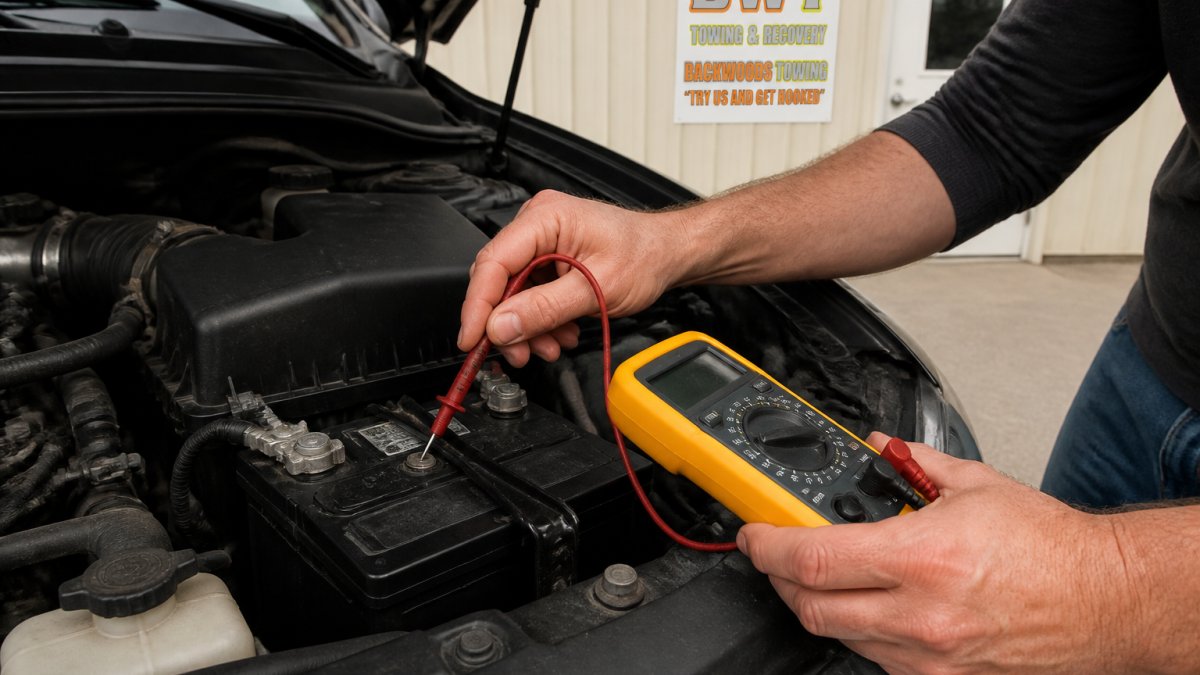
You can test a battery yourself with a cheap multimeter. Here are the numbers that matter:
| Reading (engine off) | What It Means | What To Do |
|---|---|---|
| 12.6V or higher | Fully charged | Battery is fine; look elsewhere |
| 12.4V | About half charged | Charge it and retest |
| 12.0V or lower | Discharged | Charge or jump it |
| Below 10V while cranking | Failing battery | Replace it |
Set the meter to DC volts and touch the red probe to the positive post and the black probe to the negative post. A reading under 12.0V after a week of sitting tells you the battery is the problem.
Parasitic Draw and Battery Drain While Parked
A parasitic draw is current that keeps flowing after the car is off. Every modern vehicle draws a small amount to keep the clock, alarm, and computer memory alive. That baseline is normal. The problem starts when a stuck relay, a trunk or glovebox light that never shuts off, a phone charger left in a live socket, or a failing module pulls enough current to flatten a healthy battery in a week.
If a battery that tests good keeps dying after a week of sitting, this is the cause to chase. A common pattern is a light or accessory that stays on out of sight. Check the trunk, glovebox, hood, and interior lights first, and unplug anything from the 12V sockets before you assume the battery is bad.
How to Measure Parasitic Draw
You can measure the drain with a multimeter that has a DC amps setting, but the safe method matters more than the meter.
- Make sure the battery is fully charged and the key is off.
- Open the hood and close all doors, the trunk, and the glovebox so every light is off. If a door must stay open for access, tape the door switch closed.
- Disconnect the negative battery cable.
- Set the meter to DC amps and connect one probe to the negative post and the other to the disconnected negative cable end, so the meter completes the circuit.
- Wait 30 to 60 minutes. Many modules stay awake for a while after shutdown and then go to sleep; the reading will drop once they do.
Watch out: do not crank the engine or turn on accessories with the meter in line. The starter current will exceed the meter's amp rating and can damage the meter or cause a spark. If you need to start the car, reconnect the cable first.
Isolating the Circuit
Once you confirm a draw, pull one fuse at a time from the underhood and interior fuse boxes and watch the meter. When the reading drops to the normal range, you have found the circuit. Use the fuse-box diagram in the owner's manual to see what that fuse protects, then inspect that circuit for a stuck relay, a chafed wire, or an accessory that never powers down. Replace the fuse before moving to the next one so you do not lose track of what you have already checked.
If the drain returns to normal only after several fuses are pulled, the cause may be a module that wakes other modules, which is a job for a scan tool and a shop.
Corroded or Loose Battery Terminals
Dirty terminals mimic a dead battery. Corrosion blocks current, and a loose clamp lets voltage drop under load.
Look at both posts. White or green crust means corrosion. Grab each cable and twist it gently; it should not move.
To clean them, disconnect the negative cable first, then the positive. Scrub the posts and clamps with a wire brush. Reconnect positive first, then negative, and tighten until snug.
Watch out: never let a wrench touch both the positive post and any metal part of the car at once. That causes a dangerous spark.
Fuel Issues: Pressure Loss and Stale Fuel
A car that cranks fine but won't fire often has a fuel problem. The fuel pump needs to build pressure before the engine starts. After a week, that pressure can bleed off, so the first few seconds of cranking may not deliver enough fuel.
Stale fuel is a bigger concern for longer storage. A week is usually too short to spoil gas, but old fuel already in the tank plus a week of sitting can make starting harder.
Listen for the fuel pump. Turn the key to "on" without cranking and you should hear a brief hum from the tank. No hum can mean a failing pump.
How to Jump-Start a Car That Has Been Sitting
A jump start is safe when you follow the order. Here are the steps:
- Park the good car close, engines off, and never let the vehicles touch.
- Connect the red cable to the dead battery's positive post.
- Connect the other red end to the good battery's positive post.
- Connect the black cable to the good battery's negative post.
- Connect the last black end to a bare metal bolt on the dead car, away from the battery.
- Start the good car, wait a minute, then start the dead car.
- Remove the cables in reverse order.
If the car starts, drive it for at least 20 minutes to recharge. For a full walkthrough, see our guide on how to jump start a dead battery.
Car Not Starting but Battery Is Fine: What to Check Next
If the battery tests strong and the car still won't start, the next step depends on what you heard when you turned the key. Use the symptom to pick the path instead of replacing parts.
No-Crank: Silence or a Single Click
A single loud click with no crank points to the starter, the starter solenoid, or the circuit that feeds them. Check the battery cables at both ends, including the ground strap to the engine block, and look for a loose or corroded connection at the starter. If the cables are clean and tight and you still get one click, the starter or solenoid is the likely cause.
No dash lights and no click can mean the ignition switch, a security system, or a blown main fuse. Try the spare key if the car has a chipped key; a failed transponder can cut the starter even with a good battery.
Slow Cranking: The Engine Turns but Sounds Tired
Slow cranking with a battery that reads 12.6V at rest usually means resistance in the cables or a starter that is dragging. Check the voltage at the battery posts while a helper cranks. If it holds near 10V or higher but the engine still turns slowly, the problem is downstream of the battery: a corroded cable end, a bad ground, or a failing starter.
Normal Crank, No Start: The Engine Spins but Never Fires
A healthy crank with no fire is a fuel or ignition problem. Turn the key to "on" without cranking and listen for the brief hum of the fuel pump from the tank. No hum can mean a failing pump or a tripped inertia switch.
A normal crank with no start after a week of sitting is also the classic sign of fuel pressure that bled off.
Watch out: if you smell raw fuel while cranking, stop. A fuel smell means a leak or a flooded engine, and continuing to crank can cause a fire. Ventilate the area and do not jump-start or keep cranking until the smell clears.
If you cannot sort it out in your driveway, it may be time to call for help. Our guide on getting roadside assistance for a dead battery walks through the call. If you are weighing your options, read how to choose between towing and roadside assistance. And if you just need someone nearby, Backwoods Towing offers 24/7 roadside assistance for the Buffalo, Missouri area.
Frequently Asked Questions
Why won't my car start after sitting for a week?
A car that sat for a week most often has a weak or discharged battery, especially if it is older or the weather turned cold. A small parasitic draw from the clock, alarm, or computer can pull down a marginal battery over seven days. Other causes include corroded or loose battery terminals, stale fuel, or a failing starter. Start by checking whether the engine cranks, then test battery voltage with a multimeter.
Can a car sit for 2 weeks without being started?
Yes, but a car won't start after sitting for 2 weeks more often than after just one week. Two weeks gives parasitic draw more time to drain a weak battery, and fuel begins to lose volatility. If you plan to leave a vehicle parked that long, disconnect the negative battery cable or use a trickle charger. On return, check battery voltage before trying the ignition.
What should I check if my car won't start but the battery is fine?
If the car is not starting but the battery is fine, move on to fuel and ignition. Listen for the fuel pump prime when you turn the key, check fuel pressure at the rail, and inspect spark plugs and coils. Corroded terminals and a loose starter connection can also mimic a dead battery. If voltage reads above 12.4 volts and the engine still won't crank, the starter or ignition circuit is the likely cause.
When should I call for roadside assistance if my car won't start?
Call for help when you have no jumper cables, the battery will not hold a charge after a jump-start, or the engine still will not crank after basic checks. In Buffalo, Missouri, cold snaps and rural back roads make a no-start situation riskier. Backwoods Towing offers 24/7 jump-starts and roadside assistance, so you are not stuck waiting alone on a shoulder or driveway.