 how-to
How to Jump Start a Dead Battery: 7 Steps That Work
Last Updated: November 2, 2026
Quick Summary
To jump start a dead battery, connect the red clamp to the dead battery's positive terminal and the good battery's positive terminal, then attach one black clamp to the good battery's negative terminal. Attach the final black clamp to unpainted metal on the dead car, away from the battery, then start the good car and try the dead one.
- Use jumper cables of at least 4 gauge that are 12 to 16 feet long.
- Connect positive to positive first, then negative to ground, in that order.
- Ground the final black clamp away from the dead battery to reduce spark risk.
- Let the good car run two to three minutes before trying to start the dead car.
- Remove cables in reverse order and drive at least 30 minutes to recharge the battery.
Table of Contents
- What You Need Before You Start
- How to Jump-Start a Car With Jumper Cables
- How Long to Leave Jumper Cables Connected
- Starting the Car and Removing the Cables Safely
- Using a Portable Jump Starter for a Dead Battery
- Troubleshooting: Car Won't Start After Jump-Start
- Book Roadside Help When a Jump Doesn't Work
- Frequently Asked Questions
What You Need Before You Start
A dead battery is one of the most common reasons drivers call for roadside help, and a jump-start is often the quickest fix. This guide walks you through how to jump start a dead battery safely, from gathering your gear to knowing when to stop and call for professional help.
Before you touch a single cable, gather the right tools. You will need a second vehicle with a working battery, a set of quality jumper cables (at least 4 gauge, 12 to 16 feet long), and a pair of gloves and eye protection.
Check your owner's manual too. Some newer vehicles have battery terminals in unusual spots, and a few require a jump point under the hood rather than at the battery itself.
Keep these basics in your trunk:
- Jumper cables or a portable jump starter
- Work gloves and safety glasses
- A flashlight for night breakdowns
- A rag or paper towel for wiping terminals
Park both vehicles close enough for the cables to reach, but do not let the metal bodies touch. Put both cars in park or neutral, set the parking brake, and turn off every electrical load, including headlights, radio, and climate control.
How to Jump-Start a Car With Jumper Cables
Jump-starting works by sending power from a good battery into the dead one. The process is simple, but the order matters. Mix up the steps and you risk sparks, a damaged electrical system, or worse.

Which Jumper Cable Goes On First
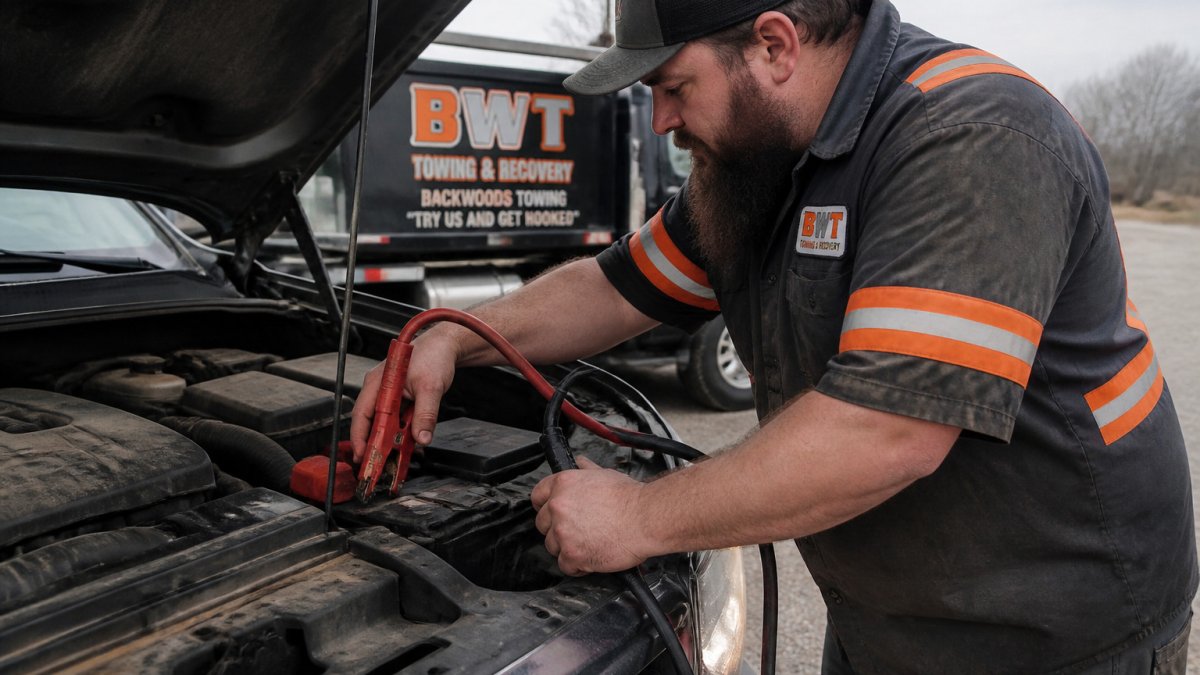
Start with the red clamp. Attach one red clamp to the positive (+) terminal of the dead battery. Then attach the other red clamp to the positive (+) terminal of the good battery.
Next, attach one black clamp to the negative (-) terminal of the good battery. The last connection goes to the dead car, as covered in the next section.
Positive to positive, negative to ground. Remember that order and you will avoid most mistakes.
Where to Connect the Negative Cable
This is the step that trips up most people. Do not connect the final black clamp to the negative terminal of the dead battery. Instead, attach it to a clean, unpainted metal part of the dead car's engine block or chassis, away from the battery.
Why does this matter? Batteries can release hydrogen gas while charging, and a spark near the battery can ignite it. Grounding the final connection away from the battery keeps any spark at a safer distance. Connecting the negative cable to the dead battery's negative terminal can be dangerous, so use a ground point instead.
How Long to Leave Jumper Cables Connected
Once all four clamps are attached, start the good car and let it run for about two to three minutes. This gives the dead battery a small charge before you try to start the dead vehicle.
Then try to start the dead car. If it turns over, let both engines run for at least five to ten minutes, which gives the battery more charge. If it does not start after a few tries, stop. Repeated cranking can overheat the starter and drain the good battery.
If the car still will not start after two or three attempts, the battery may not accept a charge, or the problem may be elsewhere. That is a sign to call for help.
Starting the Car and Removing the Cables Safely
When the dead car starts, remove the cables in the exact reverse order you attached them. This keeps stray clamps from touching each other or metal parts while they are still live.
- Remove the black clamp from the dead car's ground point first.
- Remove the black clamp from the good battery's negative terminal.
- Remove the red clamp from the good battery's positive terminal.
- Remove the red clamp from the dead battery's positive terminal last.
Keep the clamps away from each other and away from you while you work. Once the cables are off, leave the engine running. Drive for at least 30 minutes, ideally on a highway, so the alternator can recharge the battery. A short trip to the store often is not enough.
Watch out: If the clamps touch each other while still connected to a live battery, they can spark hard. Always remove the black clamp first and the red clamp last.
Remove the cables in reverse order, and keep the engine running long enough to recharge the battery.
| Step | What to do | Time or frequency |
|---|---|---|
| Remove black clamp from dead car ground | Disconnect first | Immediately after start |
| Remove black clamp from good battery | Disconnect second | Next |
| Remove red clamp from good battery | Disconnect third | Next |
| Remove red clamp from dead battery | Disconnect last | Last |
| Keep engine running | Drive to recharge battery | At least 30 minutes |
Using a Portable Jump Starter for a Dead Battery
A portable jump starter is a small lithium battery pack that lets you jump your car without a second vehicle. It is a good option for drivers who travel alone or park in remote spots.
Charge the unit fully before you need it. Connect the red clamp to the dead battery's positive terminal and the black clamp to a ground point, just as you would with cables. Then turn on the jump starter and try to start the car. Most units have indicator lights that show when the connection is correct.
Not every portable jump starter works on every dead battery. A portable jump starter may not revive every dead battery, so a jump-start should not be treated as a guaranteed fix. Check your unit's specifications for the engine size and battery type it supports.
Troubleshooting: Car Won't Start After Jump-Start
If the car does not start after a jump, work through these checks:
- Make sure all four clamps have solid contact with clean metal.
- Check that the good car's engine is running and at normal idle speed.
- Look at the battery terminals for corrosion or looseness.
- Confirm the dead battery is not cracked, leaking, or swollen.
A jump-start can fix a drained battery, but it cannot fix a bad alternator, a failed starter, or a battery that will not hold a charge. Many drivers find that the car starts after a jump but dies again within a day or two. That pattern usually points to a battery or charging system problem that needs a shop visit.
If the car starts and then dies when you disconnect the cables, the alternator may be failing. Drive straight to a repair shop rather than waiting.
Book Roadside Help When a Jump Doesn't Work
Sometimes a jump-start is not enough, or you do not have a second vehicle or a working jump starter. When that happens, professional roadside assistance is the safer choice. Backwoods Towing provides 24-hour roadside help in Buffalo, Missouri, and nearby communities, including jump-starts, lockouts, flat tires, and fuel delivery. Our team keeps you updated during service so you know what to expect.
If you are stuck after a failed jump, our guide to 5 Steps to Get Roadside Assistance for a Dead Battery explains what to do next. For immediate help, see our Emergency Roadside Assistance: Your 24-Hour Guide. If you are ready to hire help now, you can find a roadside towing service near you. Still deciding between a tow and roadside assistance? Our overview of how to choose between towing and roadside assistance can help you decide. If your breakdown happens after dark, read what to do when your car breaks down at night.
Call Backwoods Towing today and let our local team get you back on the road.
Frequently Asked Questions
How do you jump-start a car with a dead battery?
Park the running vehicle close enough for the cables to reach, turn both engines off, and connect the red cable to the dead battery's positive terminal and the other red end to the good battery's positive. Connect the black cable to the good battery's negative terminal, then attach the final black clamp to unpainted metal on the dead car, away from the battery. Start the donor car, wait a few minutes, then try starting the dead car. Remove the cables in reverse order once it runs.
How long should you leave jumper cables connected?
Leave the cables connected for about two to five minutes while the donor vehicle runs, giving the dead battery time to take a partial charge. If the car does not start after a few tries, stop and check the connections rather than cranking the starter repeatedly, which can overheat the starter motor. Once the engine runs, remove the cables in reverse order and keep the engine running for at least 15 to 30 minutes so the alternator can recharge the battery.
Can you jump-start a car with a portable jump starter instead of another car?
Yes. A portable lithium jump starter can start a car without a second vehicle, but it only works under specific conditions. These devices may not revive every dead battery, so a jump-start should not be treated as a guaranteed fix. Charge the unit fully before use, connect the clamps to the battery terminals with the correct polarity, and follow the manufacturer's instructions for your model.
What should you do if your car won't start after a jump?
Confirm the clamps are firmly attached to clean metal and that the donor car is running. Check for loose battery terminals or corrosion, and make sure the headlights and dashboard lights are bright on the donor vehicle. If the car still won't start, the battery may be too damaged to hold a charge, or the problem could be the starter, alternator or fuel system. Call for roadside assistance rather than repeatedly cranking the engine.